
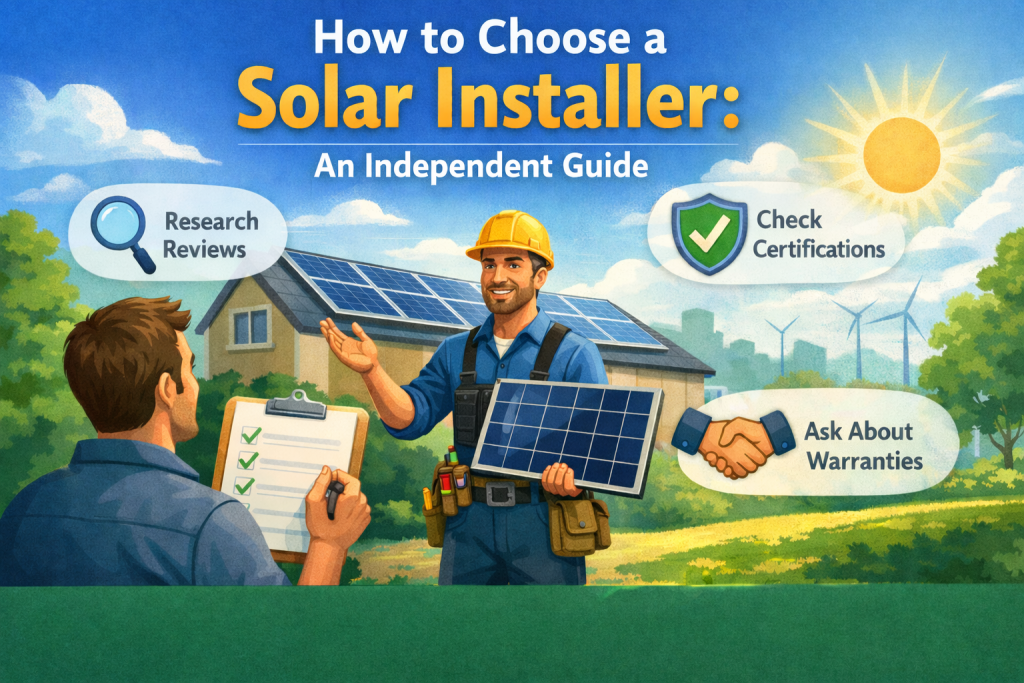
Installing a solar system is a long-term financial and technical decision. The quality of the installer often has a greater impact on system performance and reliability than the equipment itself.
This guide outlines a neutral framework for evaluating solar installers based on objective criteria, independent of any specific company or brand.
Why Installer Choice Matters More Than Equipment
Most solar panels and inverters are manufactured by a limited number of global suppliers. Differences between major brands are usually incremental.
By contrast, installation quality directly affects:
- System safety
- Energy yield
- Equipment lifespan
- Warranty validity
- Future maintenance costs
Poor installation can reduce real-world performance by 10–30%, regardless of panel quality.
Step 1: Verify Legal and Business Status
The installer should be:
- A registered legal entity
- Operating under a clear business license
- Able to issue invoices and warranties
Red flags include:
- Cash-only operations
- No registered company name
- No physical office or service location
Step 2: Evaluate Technical Competence
A qualified installer should provide:
- System design documentation
- Inverter and panel model specifications
- Electrical diagrams
- Grounding and safety plans
Key questions to ask:
- Who performs system design?
- Are certified electricians involved?
- Is system monitoring included?
Step 3: Compare Price Using Price per Watt
Total price alone is misleading.
The correct metric is price per watt (currency / Wp).
This allows:
- Fair comparison across different system sizes
- Detection of overpricing or underpricing
Extremely low prices often indicate:
- Inferior components
- No warranty
- Inexperienced labor
Extremely high prices often indicate:
- Unnecessary margins
- Brand premiums
- Information asymmetry
Step 4: Understand Warranties
Warranties typically include:
- Panel performance warranty (20–25 years)
- Inverter warranty (5–12 years)
- Installation workmanship warranty (1–5 years)
Clarify:
- Who services warranties?
- What happens if installer closes?
- Are spare parts available locally?
Step 5: Review Past Projects
Ask for:
- Photos of completed installations
- System sizes
- Installation locations
- Client references
Look for:
- Proper cable management
- Correct panel tilt and spacing
- Clean inverter installation
- Weatherproof grounding
Step 6: Avoid Brand Obsession
No single equipment brand guarantees system quality.
More important than brand:
- Correct system sizing
- Proper electrical design
- Correct inverter selection
- Installation standards
Brand alone should never justify:
- Large price differences
- Lack of documentation
- Missing warranties
Step 7: Use Market Benchmarks
Always compare offers against:
- Regional median prices
- Market price ranges
- Typical system sizes
Market benchmarks protect consumers from:
- Overpricing
- Hidden costs
- Manipulative sales tactics
Step 8: Understand Financial Payback
A realistic solar evaluation includes:
- Installation cost
- Annual energy production
- Local electricity tariffs
- Maintenance expectations
Payback should be expressed as:
- A range, not a single number
- Based on conservative assumptions
Regulatory frameworks can affect financial payback as well.
Step 9: Avoid Pressure Sales
High-pressure tactics indicate:
- Misaligned incentives
- Commission-driven sales
- Information asymmetry
Reliable installers encourage:
- Time for evaluation
- Independent verification
- Comparative analysis
Step 10: Use Independent Platforms
Independent platforms that:
- Verify installers
- Compare offers
- Publish market data
significantly reduce:
- Fraud risk
- Overpricing
- Technical mistakes
Key Takeaway
Choosing a solar installer should be treated as:
A technical procurement decision, not a retail purchase.
The optimal process is:
- Verify legality
- Compare price per watt
- Validate technical design
- Check past projects
- Use independent benchmarks
This approach minimizes financial risk and maximizes long-term system performance.
Published 29/01/2026